
Electronic devices look simple from the outside. However, they involve complex components such as resistors, capacitors, and chips. All these components are mounted on the PCB (Printed Circuit Board) of these electronic devices through SMT technology. But many don’t know about SMT meaning in electronics.
Generally, SMT is confused with SMD, which is obviously wrong. SMT is a technology or process for mounting components on printed circuit boards. It helps mount these components without creating holes in the board. In the past, components were fitted to boards through holes. In this article, I’ll explain everything about the SMT technology.
What Does SMT Mean in Electronics?
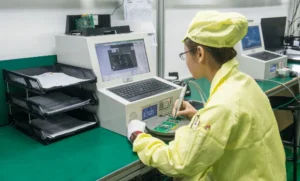
SMT stands for “Surface Mounted Technology,” which has been in use since the 1970s.
The SMT process allows manufacturers to attach small electronic components to the circuit board. This method uses solder paste on the surface of circuit boards. In this way, manufacturers don’t create holes or use wires to connect those tiny components on the boards.
In the past, THT (Through-Hole Technology) was prevalent in the electronics industry. It involved creating holes in the circuit board. Once done, the electronic parts are inserted into these holes. The creation of holes and the use of wires during that process make it less efficient. Additionally, component size was limited because they had to fit into those holes.
SMT technology offers greater convenience for attaching components to circuit boards. These components can be either resistors, chips, diodes, capacitors, or so on. This modern technology was first introduced back in the 1960s. It eliminates the need to create holes on the PCB. Remember, Through-Hole Technology was less safe for the PCB as well.
In SMT, solder paste is all that manufacturers need to attach those tiny components to a circuit board with precision. What I like about SMT is that it makes the electronic device more compact and lightweight. That’s because this modern method can bind the smallest components of circuit boards. So manufacturers use tiny components, making the electronic gadget compact.
How Does SMT Work in Electronics?
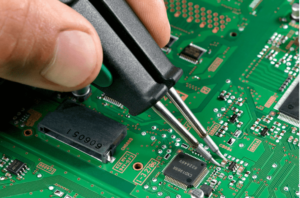
SMT technology works in three steps, enabling strong attachment of PCB components. However, each of these steps requires utmost care and precision. Small mistakes in any of those steps can damage the tiny electronic components or chips.
Step 1- Use of Paste on PCB
As I mentioned earlier, SMT uses solder paste rather than holes or wires. This paste is put on the surface of the circuit board. Are you wondering what this paste is made of? It is actually metallic particles mixed with a chemical. This chemical, known as flux, helps melt the metallic pieces during soldering.
This paste is not applied randomly on the circuit. Why? The reason is that slightly higher or lower paste on the surface can lead to serious consequences. This paste must be applied on the spot where tiny components will be attached. For this purpose, a dedicated stencil is used. This stencil helps put paste in the right place, not randomly apply it all over the circuit board.
Step 2- Placement of the Tiny Components
Once the solder paste is applied, the next step is component placement. As I said earlier, electronic devices use tiny components for their working, i.e., microchips. You cannot put them precisely on the PCB. Placing these microcomponents with precision is next to impossible. Therefore, manufacturers use high-end automated machines.
These Pick-and-Place machines pick the tiny components and place them precisely on the circuit board. These machines are guided through a dedicated computerized system. At this step, the solder paste is still sticky and holds the components placed by the machine. Mishandling of electronic components during this step can affect their performance. Therefore, the use of automated machines is necessary.
Step 3- Heating the Solder Paste in the Oven
The last step is to heat or solder the paste on the circuit. Paste itself is sticky; however, it cannot keep holding those components for long. Therefore, this paste must be heated to melt. Upon cooling, this paste will permanently hold the electronic components in place.
For heating, the PCB with paste and components is placed in an oven. It is noteworthy that the oven temperature is precisely controlled and maintained. The solder paste melts due to exposure to consistent heat. After heating, the circuit board cools, allowing the molten paste to solidify.
During solidification, it forms strong bonds with the components. In this way, the elements remain permanently attached to the circuit. The oven temperature should not be too high or too low. High temperatures can damage tiny electronic components, as they are heat-sensitive.
If the temperature is too low, the solder paste may not melt, resulting in no bonding to the circuit board. SMT technology requires a precise approach to ensure components bind smoothly on the PCB. After these steps, the PCB undergoes inspection to verify the quality of part attachment.
Advantages of Surface-Mounted Technology (SMT)

As mentioned earlier, SMT technology significantly impacts PCB size. In the past, these boards were large, leading to larger devices. However, SMT has reduced board size by enabling tiny components to be attached to boards. Here are some more benefits of this SMT technology.
1- Faster Production Speed
This technology has increased the speed of circuit board assembly. In this method, machines place components on a circuit board. They can put hundreds of tiny components in minutes, if not seconds. This allows manufacturers to assemble more circuit boards and make more electronic devices. In the past, mounting these components of a circuit was a very slow process.
2- Reduce PCB Area & Weight
SMT technology allows mounting tiny chips on the PCB surface without creating holes. If there were holes, the components would have to be larger to fit. Modern PCBs feature very small components, yet their performance is superior to that of older, larger ones. The use of these small components has reduced the PCB’s size. A smaller PCB size ensures compact electronic devices with less weight. Remember, these miniature electronic parts are a lot lighter, which is a significant advantage.
3- Production with No Human Errors
SMT technology requires minimal human effort for component mounting. Placing the tiny chips is a more critical step in these methods. This step is performed entirely by automated machines, resulting in precise placement. As a result, the SMT reduces the common human errors that occur when human effort is involved. As a result, the success rate of mounting these parts on circuit boards is very high.
4- Better Performance
With SMT, the performance of electronic devices becomes more reliable. This is mainly due to the shorter path that electrical signals have to cover. These SMT technologies reduce PCB size and allow components to be closer together. So, signal loss is very minimal, resulting in more reliable performance. Additionally, the solder paste melts, cools (solidifies), and forms a strong bond with components and the circuit board. So vibrations or sudden shocks don’t compromise the integrity of the PCB or its components.
5- Lower Cost of Manufacturing
The old through-hole component-mounting method was expensive. It also resulted in wasted circuit board material due to the holes. However, SMT technology has significantly reduced PCB assembly costs. The reason is that this method uses machines to mount components on the board. Additionally, the circuit board is not cut or has no holes, resulting in no material waste. All these factors make PCB fabrication cost-effective.
Disadvantages of SMT in Electronics
There are three prominent drawbacks of SMT technology. Those include:
- The PCB becomes more complex
- Smaller components are easy to break
- The components are close together and are difficult to repair
The SMT process allows manufacturers to attach hundreds of tiny components to a single PCB. This is beneficial because it reduces the circuit’s size and allows more components to be placed in a single location. However, it makes the circuit board more complex and confusing, especially for beginners. Additionally, such small components, when packed together, can break or fail.
If one component among the lot fails, it can affect the working of almost all the other components attached. Since these components are tiny, repairing them can be challenging. However, none of these drawbacks is severe enough to stop the use of SMT. Despite this, the technology is widely used in the electronics industry.
Frequently Asked Questions
What is the purpose of SMT?
The primary purpose of SMT is to mount the electronic components on the PCB. It is a process that uses paste to attach these components. As a result, PCB assembly becomes more efficient and takes less time.
Are SMT and SMD the same?
No. SMT is a process that allows us to mount components of PCBs. However, SMDs refer to smaller components or devices mounted on the surface of circuit boards. Those devices can be diodes, resistors, and more.
Conclusion
It’s fair to say that SMT has changed the electronics industry. Before this technology, the electronic devices were bigger and bulkier. The process of mounting components to PCBs was less efficient. However, this process allows manufacturers to attach chips to the circuit boards without creating any holes on the PCB. As a result, electronic devices have become more compact and perform better. In this article, you’ll learn everything about the Surface Mounted Technology (SMT) and how it works.