
When to Use Flexible and Rigid-Flex PCBs: Real Applications in Wearables and Medical Devices
Are you planning to use flex PCBs on your projects? Can’t decide whether to use flexible or rigid-flex on them. This article should help you with your decision.
Introduction
Modern flex PCBs emerged when polyimide films were developed in the 1960’s. With this, fabricating multiplayer flex circuits became a reality. The board utilizes the copper, adhesive, and polyamide stackup that still exists today.
However, during the 80’s, the SMT process was developed. During the same period, both multilayer flex and rigid-flex circuits came about. This method allowed flex circuits to be installed on devices with tight space constraints, such as mobile phones, laptops, and medical devices.
Here, you’ll learn more about when to use flexible and rigid-flex PCBs and their real-world application in wearables and medical devices. If you have queries regarding flex and rigid-flex PCBs, UET PCB (https://uetpcb.com/flexible-pcbs/) is always here to help. UET is an expert in manufacturing flex and rigid-flex PCBs and has been in this industry for over 20 years.
Flexible vs. Rigid-Flex PCBs
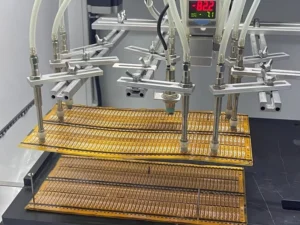
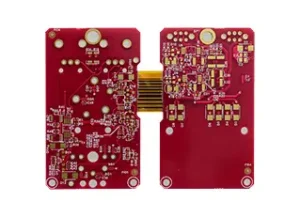
Flex PCBs (often abbreviated as FPCs, or also called flex circuits) are circuit boards that can be bent because they are constructed with polymer films instead of the usual rigid parts. They have a flexible substrate usually made of polyimide, polyester, or even PEEK (Polyether‑Ether‑Ketone). You’ll usually find in their stack-up coverlay (protective film) the polyamide dielectric, adhesive sections, annealed copper conductive layers, and optional stiffeners.
Rigid-flex PCBs combine rigid (e.g., FR4-based) and flexible PCBs. Both the rigid and flex sections are laminated together into a single piece; hence, no connectors are needed. The flex part is the usual one, made of a polyamide substrate. The rigid part sandwiches the flex part through the inner layers, serving as a conductive inner layer. Rigid-flex PCBs eliminate costly FPC connectors in production lines.
The Advantages of Using Either Flex or Rigid-Flex PCBs on Your Wearables and Medical Devices
Both flex and rigid-flex PCBs have their own advantages and disadvantages when used in a product. It all boils down to form, function, signal integrity, manufacturing costs, serviceability, and the assembly process.
When to use Flex PCBs in wearables?
Flex PCBs will make your circuit modular and flexible. If you work in a tight space inside your casing and need a small room for bends, then using flexible PCBs is the way to go. Additionally, the human body is contoured and can move significantly, making it ideal for flex PCBs. You’ll find many flexible circuits used in conjunction with bending scenarios in wearables, and other areas, such as:
● Heart Rate Sensors
● ECG Electrodes
● Wearable straps
● Smart Clothing
● Display flex cables
● Vibration motor flex cables
When should you use rigid-flex PCBs instead?
Since rigid-flex PCBs have flex PCBs built into them, rigid-flex can usually handle most applications where flex PCBs can. However, it’s not a simple scenario; there’s more to using rigid-flex over flex circuits (or vice-versa). It essentially boils down to:
1. Overall cost of making the circuit
2. Assembly or build cost
3. Sub-assembly suppliers
4. Signal integrity
5. Repairability and service
6. Product reliability and compliance
7. Parts replacement
Note that the cost of a rigid-flex PCB is higher than that of a rigid + flex PCB (with connectors). This scenario is due to the cost of fabricating a flexible material with a rigid material in a single lamination sequence. However, do note that sometimes, you have to look at the bigger picture. PCBs with cheap FPC connectors may need to be assembled by hand in an assembly line. Eventually, you may see that the fabrication cost of rigid-flex PCBs catches up as you scale your products into the thousands.
Another thing to consider is that eliminating connectors can improve the reliability of high-speed signals. Additionally, in your DVT compliance, you may have a more robust end product that can withstand vibration tests.
Serviceability in the Field
A good product can fail during its lifetime. With this, you should be able to service it. It’s easier to service and replace parts if you have a flex PCB coupled with a connector for that part. Such parts as motors, cameras, CD/Blu-ray lenses, and other PCBs, etc. It can be cumbersome and time-consuming if the manufacturer omits the connector along with the flex part.
In contrast, rigid-flex PCBs are more commonly used in non-serviceable products. This situation indicates the product is expected to have a low failure rate and high reliability throughout its lifetime. These products are usually sealed, waterproof, dustproof, and even mechanically stable. Though these products may be more expensive to manufacture, they are expected to last for a lifetime.
Example of Flex PCB Designs
Smart Watch
Use Rigid-Flex PCB
The circuit board of a smartwatch almost always requires a rigid-flex PCB. The reason is that rigid-flex gets rid of connectors. Connectors are one of the biggest failure points in smartwatch applications and even on some wearables.
Smart watches are prone to sweat, cold, heat, vibration, repetitive motion, shock, and oxidation, which can cause significant wear and tear. This situation is a perfect application for rigid-flex PCBs because it is sealed, mechanically stable, waterproof, and dustproof. In line with this, smart watches are expected to have a low failure rate and to last long.
Here are some design considerations for smart watches:
● The SoC and Power Management sections are put in the rigid PCB part.
● Flex PCBs are used for connecting to the battery, display, sensors, etc.
● RF sections are on a rigid PCB with controlled impedance.
● No FPC connectors are used to improve reliability.
Electronic Medical Grade ECG Patch
Use Flex PCB
An Electronic ECG patch can benefit from a Flex PCB because it will be worn on a patient’s chest. The ECG sensor can connect to a flexible, bendable PCB that adapts to the contours of the human body. Additionally, the flex part should be non-toxic, and use low-cytotoxicity polyimide material. This ECG patch is meant to be disposable.
Design considerations:
● Must pass ISO10993 cytotoxicity test.
● Use nickel-free material on surfaces that touch the human body.
● Lightweight and bendable.
● Use low-cost materials since they are disposable.
Additionally, other medical devices can use disposable flex PCBs, such as blood glucose sensors, pregnancy test strips, and single-use medical sensors.
Conclusion
There are several real-world applications for flex and rigid-flex PCBs in wearables and medical devices. This article presents some of them, highlighting both the advantages and disadvantages of using either a flex or a rigid flex structure. Finally, UET PCB is an experienced PCB/PCBA manufacturer that can help fabricate your medical/wearable devices using these flex circuits.