
When creating a PCB project, one of the first steps is defining a PCB stackup. With this, you need to know which PCB material to use. You won’t be able to define a dielectric constant, which is critical for your impedance-controlled lines, if you haven’t decided on your PCB material yet.
Additionally, you’ll have to factor in cost, mechanical/electrical properties, durability, thermal characteristics, to name a few. These choices are the reason why you need a trusted PCB fabricator to help you make your decision. UET PCB (https://uetpcb.com/components-sourcing/) can help you with all your PCB material selection and component needs.
New vs. Old PCB Material Technology in 2026
With innovations come additional material selection. This part tackles the different materials that came about in the following era.
FR4
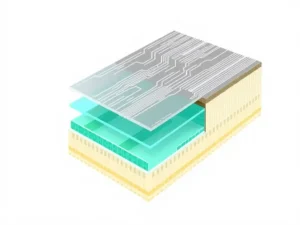
Back in the days, FR4 was the most prevalent PCB material. Introduced in 1968, FR4 has been the universal standard in PCB fabrication to date. You’ll find that about 70 – 80 % of the PCBs of electronics use FR4 today.
FR4 properties:
- Cost effective
- Mechanically strong
- Stable dielectric constant
- Good Electrical insulation
- Good Thermal resistance
- Good Chemical resistance
- Easy to fabricate
However, FR4 can have mechanical and thermal limitations. This material has a rigid structure and glass transition temperature of Tg = 130 °C – 180 °C. It also has a decomposition temperature of Td = 300 °C – 340 °C. With these characteristics, FR4 is not meant for high temperatures and harsh environments. Additionally, FR4s have a higher variability in dielectric constant (Dk, 4.2 – 4.8) and higher loss of Tangent (Df, 0.015 – 0.025), which can degrade signals as the frequency increases. That is why other PCB materials are being used today, such as polyimide, Rogers, PTFE, etc.
Polyimide
It was around the latter part of the 1960’s that polyimide film was developed for flexible electronics and aerospace applications. Polyimide can withstand flexing and bending while maintaining high-temperature and harsh environment resilience. Though this PCB material can be more expensive to produce than FR-4, it offers several notable properties. Polyimide is widely used in smartphones, wearables, tablets, and laptops as flex or rigid-flex PCBs.
Polyimide properties:
- Extreme heat resistance
- Very flexible
- High tensile strength
- Vibration resistant
- Electrical stability across temperature and frequency
- Ultra-thin and lightweight
- High insulation resistance
Rogers
In the 1980s, the RF and microwave era began. With higher-frequency requirements, PCBs needed stability in their electrical, thermal, and mechanical characteristics. As a result, low-loss FR4, PTFE and Rogers materials were developed. Each of the said materials has advantages over an RF frequency range, and includes better thermal, mechanical, and manufacturability properties. With this, you’ll find many Rogers PCBs on 4G, 5G, and IoT communication devices.
Examples of Roger material properties are Dk (Dielectric Constant), Df (Dissipation Factor), and Rz/Ra (Copper Roughness). As an example, Rogers-based materials have these properties:
Rogers properties:
- Low Dielectric constant (Dk/εr) means it can accommodate faster signals, depending on the material grade (e.g., RO4000 – 500 MHz – 20 GHz, RO3000 – 30 GHz, RT/duroid – 40 – 100 GHz)
- Low Tangent ((Df/tan δ) means low signal loss at higher frequencies.
- High thermal conductivity and low coefficient of thermal expansion (CTE) – means it can act as a better heat spreader and it expands less with increasing heat, respectively.
- Low moisture absorption means it can perform well even in a humid environment.
- Can maintain its size and shape under certain stresses
PCB Materials Costing
You should be able to make accurate PCB fabrication costing now that you know the differences between several PCB material technologies. Find the advantages and disadvantages of using the particular PCB materials in relation to cost below.
FR4 Advantages/Disadvantages
FR4 should give you the best bang for your buck in terms of cost. FR4 is meant for almost any general-purpose electronics requirement that has below 1 GHz frequency requirements. However, because of the variability of FR4’s Dk (Dielectric constant) at higher frequencies, it’s impossible to control performance drifts across temperature changes. This characteristic is critical for impedance-controlled lines. Additionally, the higher Df (loss tangent) presents signal attenuation at higher frequencies. You’re sure to have poorer antenna efficiency if you use FR4 for higher microwave or mmWave frequency applications.
Polyimide Advantages/Disadvantages
If your project requires bending and has high thermal or mechanical requirements, polyimide is the way to go. Note that just like FR4, Polyimide falls short with a higher loss tangent (Df) (0.0004 – 0.009) and variable dielectric constant (Dk). With this, polyimide is seldom used for high-frequency microwave / mmWave applications.
However, polyimide shines when it comes to harsh environments (such as in aerospace, oil &gas, and military), and you’ll definitely get your money’s worth for it. Additionally, polyimide will serve you well if you’re into smartphones, wearables, and sealed non-serviceable electronics.
Rogers Advantage/Disadvantages
The best use case of using Rogers materials is in higher microwave / mmWave PCB designs. Rogers has all the distinct advantages in Dk and Df. Additionally, some Roger materials can mimic the ease of manufacturability of FR4 PCBs. This characteristic is an advantage compared to another high-frequency material called PTFE, which is a Teflon-based laminate. PTFE is hard to manufacture as it requires additional fabrication processes. PTFE needs special bits, additional plating adhesion materials, and requires special multilayer lamination cycles. This process makes Rogers a cheaper alternative to PTFE.
Rogers materials applications include 4G, 5G, and IoT designs. 5G can extend further to mmWave (30 GHz to 300 GHz). It’s impossible to use FR4 or Polyimide materials in these PCB designs. With this, Rogers materials have become the preferred choice for modern communication systems due to their superior RF performance and manufacturability.
Conclusion
FR4, Polyimide, and Rogers are some of the most popular PCB materials up-to-date. You should be aware of which material to use for your PCB designs. Also, you should always factor in cost, particular application, and ease of manufacturability in your choices. With this, choose a PCB fabricator with extensive know-how and experience in this field, such as UET PCB. UET PCB has been a trusted partner with over 15 years of experience in the electronics industry.